

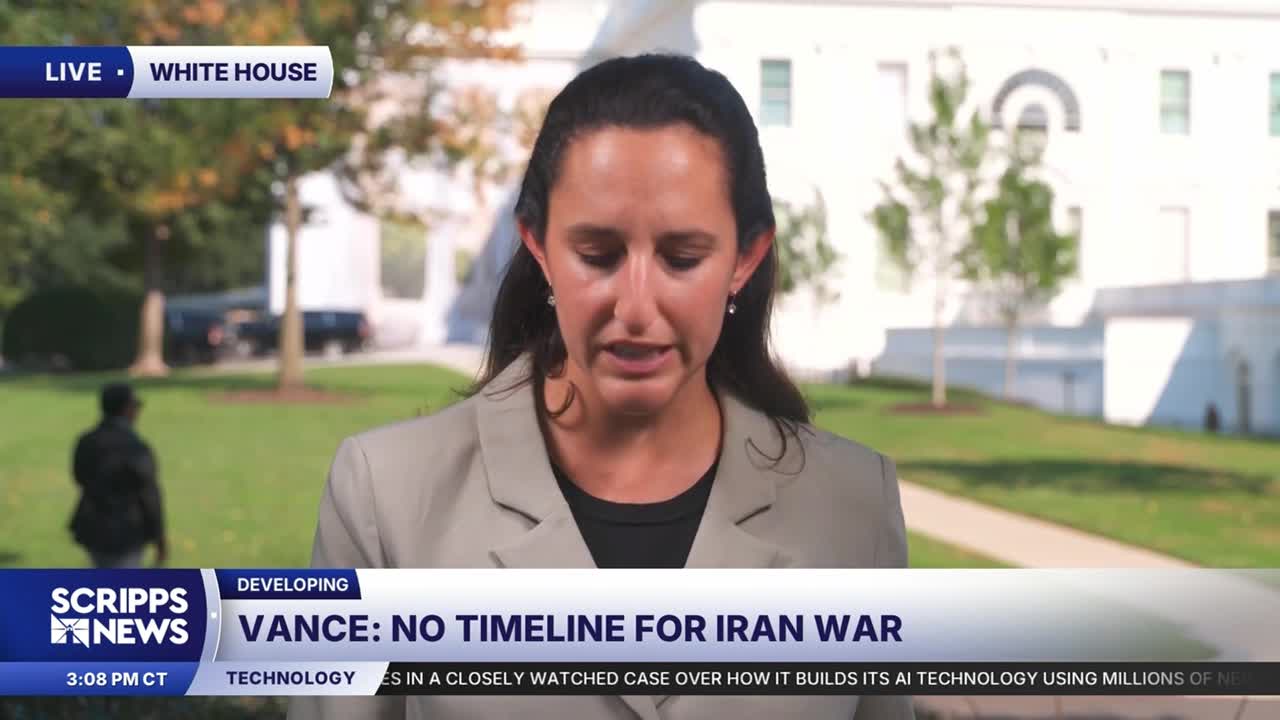


Vice President JD Vance could provide neither a timeline for the Iran war to end nor a date when gas prices might sink below pre-war levels during a White House appearance Thursday, suggesting instead it was up to Iran to conclude the conflict that began with joint US-Israeli airstrikes six months ago.
The current hostilities shouldn’t even be called a “war,” Vance argued, since “active combat operations” ended months ago.
“Right now, there is no active shooting,” Vance insisted, despite three consecutive days this week when the US and Iran exchanged fire, including around the Strait of Hormuz.
The description of the Middle East situation as an occasional, low-grade battle was a sign the administration is trying to place the war in the rear-view mirror two months ahead of critical midterm elections, even as the US military continues actively targeting Iranian positions. Updated casualty figures from the Pentagon on Thursday showed 790 US service members have been wounded and 18 killed since the conflict began in late February.
RELATED STORY | Trump signs order to tighten rules around mail-in voting, setting up likely legal challenges
On Tuesday, the US conducted a multi-faceted operation, hitting nearly 60 military targets around the strait — including air defense sites, radar systems, maritime assets, mine-laying capabilities and communications sites — while simultaneously escorting ships through the waterway.
The US military expects to continue conducting offensive strikes near the strait, in part because Iran has demonstrated it has the capacity to reconstitute its capabilities. Conducting those strikes amounts to “mowing the grass” or a game of “whack-a-mole,” officials said.
Although Tuesday’s operation was a success, officials are under no illusion that a swift solution to the conflict is close. And energy companies are still wary about the huge risks involved in sending their ships through the strait, even with military escorts.
The unpopular war has caused an uptick in gas prices, prompting anxiety among Republicans looking to maintain congressional majorities.
Trump insisted this week he feels no pressure to wind down hostilities before ballots are cast. But his advisers and allies all concede the further the war recedes from view in the lead-up to November, the better.
Vance, who initially opposed going to war with Iran, played a leading role earlier this summer in trying to broker a diplomatic settlement. But the ceasefire he negotiated fell apart after two weeks, and the two sides returned to a cycle of back-and-forth strikes as Iran sought to maintain control of the strait.
Calm prevailed for most of August. But the strikes resumed this week when the US took out Iranian positions near the strait it said were preparing to launch mines into the waterway. Vance said the administration is investigating reports that the latest US strikes killed four people attending a wedding celebration in a village near the Strait of Hormuz, declining to rule out that civilians were killed while insisting the military “never targets civilian in combat.”
“We never will do that, we never have done that, and unfortunately, obviously, sometimes things happen, but in this particular case, I don’t think that we have any information one way or the other,” Vance said.
Tehran retaliated against the latest US strikes by targeting American bases in the region.
Now, there are no talks underway with the Iranians, Vance said.
RELATED STORY | Trump administration asks Supreme Court to allow mail-in voting limits before midterms
“The president’s been very clear,” he told reporters at Thursday’s press briefing. “We’re not talking to them, and we’re not going to talk to them unless they stop shooting at commercial shipping.”
That leaves an uncertain timeline for concluding the conflict. Vance could not say whether it would end by the elections, which fall on November 3.
“When you ask when will this end, you’re asking me a question like when will the Iranians stop shooting at ships? I think the reality is I don’t know the answer to that question,” he said. “You would have to ask the Iranians.”
The vice president would also not say when gas might become cheaper.
“I’m not going to make a promise about when it’s going to return to $3,” he said. “What I will say is that we have to remember why are we doing this? Number one, it’s so that Iran never has a nuclear weapon.”
Vance was speaking from the White House briefing room, which had gone unused by the administration for 42 days. Press secretary Karoline Leavitt left the job last week, and Trump has not named a replacement.
Vance spoke for nearly an hour, taking questions on everything from the Iran conflict to his own slimmed-down figure, which he attributed to a diet prescribed by Health and Human Services Secretary Robert F. Kennedy Jr.
“I eat a lot of high protein stuff and I eat a lot of sauerkraut,” he said, describing the regime as somewhat less than appetizing: “If you want to enjoy what you eat, do not call Bobby Kennedy.”
He also offered robust support for another Cabinet member, Defense Secretary Pete Hegseth, whose management of the Pentagon has come under scrutiny amid turmoil prompted by firings, blocked promotions and resignations of senior officers.
Army Secretary Dan Driscoll — a close friend of Vance from their days together at Yale Law School — became the latest Pentagon departure when he submitted his resignation this week. That left the Army without its top civilian leader.
Hegseth — who served in the Army National Guard for nearly 20 years — has taken particular interest in the Army and its leadership, firing or forcing out several key leaders in the service.
And even some prominent retiring Republicans have called for Hegseth to go. Sen. Thom Tillis of North Carolina, who was a crucial vote to confirm the defense secretary last year, said he had “never witnessed more inept management of the brave men and women who serve our country.” He also said Hegseth was “intimidated by competence.”
Vance, however, downplayed the departures, and said instead that Hegseth was working to reform the military.
“America has fought a lot of wars since I’ve been alive, 42 years, and we have won almost none of them until Donald J. Trump became the president of the United States,” he said.
The-CNN-Wire™ & © 2026 Cable News Network, Inc., a Warner Bros. Discovery Company. All rights reserved.
