

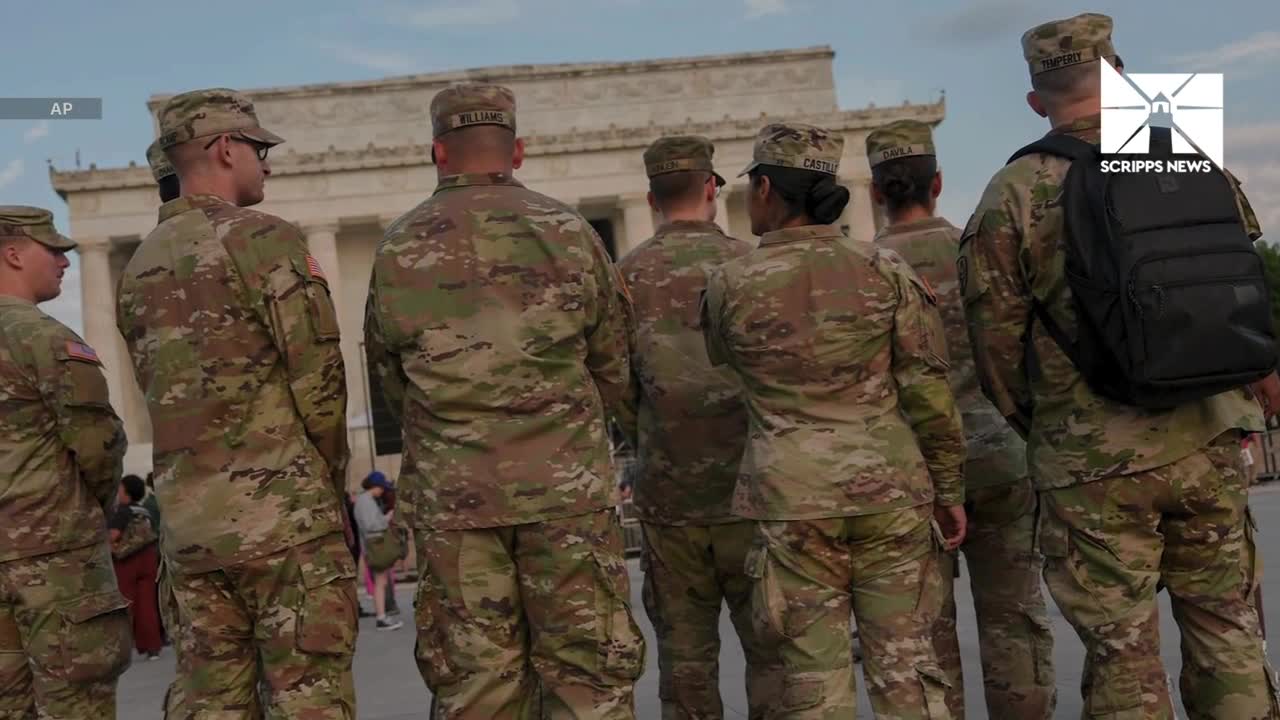


A newly revealed Department of Homeland Security memo shows the Trump administration explored a legal pathway to use National Guard troops in immigration enforcement, prompting criticism from legal experts who say the effort pushes the boundaries of federal law and long-standing limits on military involvement in domestic policing.
The April 2025 memo, obtained by watchdog group American Oversight through a Freedom of Information Act request, was sent to state attorneys general and outlines circumstances under which National Guard troops could “perform immigration functions.”
RELATED STORY | Deportation crackdown accelerates with highest ICE arrest total in months
The memo argues that Guard members deployed across state lines become federal employees and could then be designated as immigration officers under a section of U.S. immigration law, Section 1103(a)(6). The document further argues that doing so would not violate the Posse Comitatus Act, the law that generally bars the military from carrying out civilian law enforcement inside the United States.
Joseph Nunn, counsel for liberty and national security at the Brennan Center for Justice, said the administration’s legal theory lacks support in the courts.
“What DHS is suggesting in this memo, in a kind of conclusory and cavalier fashion, is that section 1103(a)(6) is one of these exceptions,” Nunn said, referring to statutory exceptions to the Posse Comitatus Act.
“No court has ever said that it is an exception to the PCA,” he added. “You will not find it in the list of statutory exceptions to the PCA.”
The Posse Comitatus Act has long limited the use of federal troops in civilian law enforcement, though exceptions exist during emergencies or when authorized by Congress, including under the Insurrection Act.
The memo comes as the Trump administration has increasingly tested the limits of military involvement in immigration enforcement and other domestic operations during the president’s second term.
“The principle in the United States, going back to the founding, has always been that the use of the military domestically is a break-glass-in-case-of-emergency type tool,” Nunn said.
“This administration has attempted to insert the armed forces into routine law enforcement on a scale that has no precedent in modern American history,” he added. “Much of those efforts have been focused on immigration, but I would say not all of them.”
IN CASE YOU MISSED IT | ICE plans to buy vehicle stopping device after fatal pursuits
National Guard troops have already supported some Immigration and Customs Enforcement operations, including providing security for agents conducting arrests. There is no public evidence Guard members have directly carried out immigration arrests under the authority described in the memo.
In a statement to Scripps News, a DHS spokesperson said, “We will let the letter speak for itself.”
Civil liberties advocates warn the legal rationale could extend beyond immigration enforcement.
“Combined with the administration’s escalating claims about noncitizen voting, this theory could be used to put military forces near polling places under the guise of immigration enforcement,” said Chioma Chukwu, executive director of American Oversight. “The stakes extend well beyond immigration: This memo gives the president a ready-made workaround for using military power at home whenever the administration decides its agenda demands it.”
“It’s difficult to overstate the degree to which this administration’s use of the military domestically is unprecedented in terms of scale and scope,” Nunn said. “We have never seen a modern president attempt to use the military at home in so many ways.”
Nunn said military involvement in immigration enforcement has steadily expanded over decades at the U.S.-Mexico border under administrations of both parties, but warned the latest effort represents a broader shift inward.
“In some ways you can understand what we’re seeing now as a process of actions that became normalized at the border moving into the interior of the country,” he said. “What happens when it expands again, outside of immigration into other substantive areas?”
