

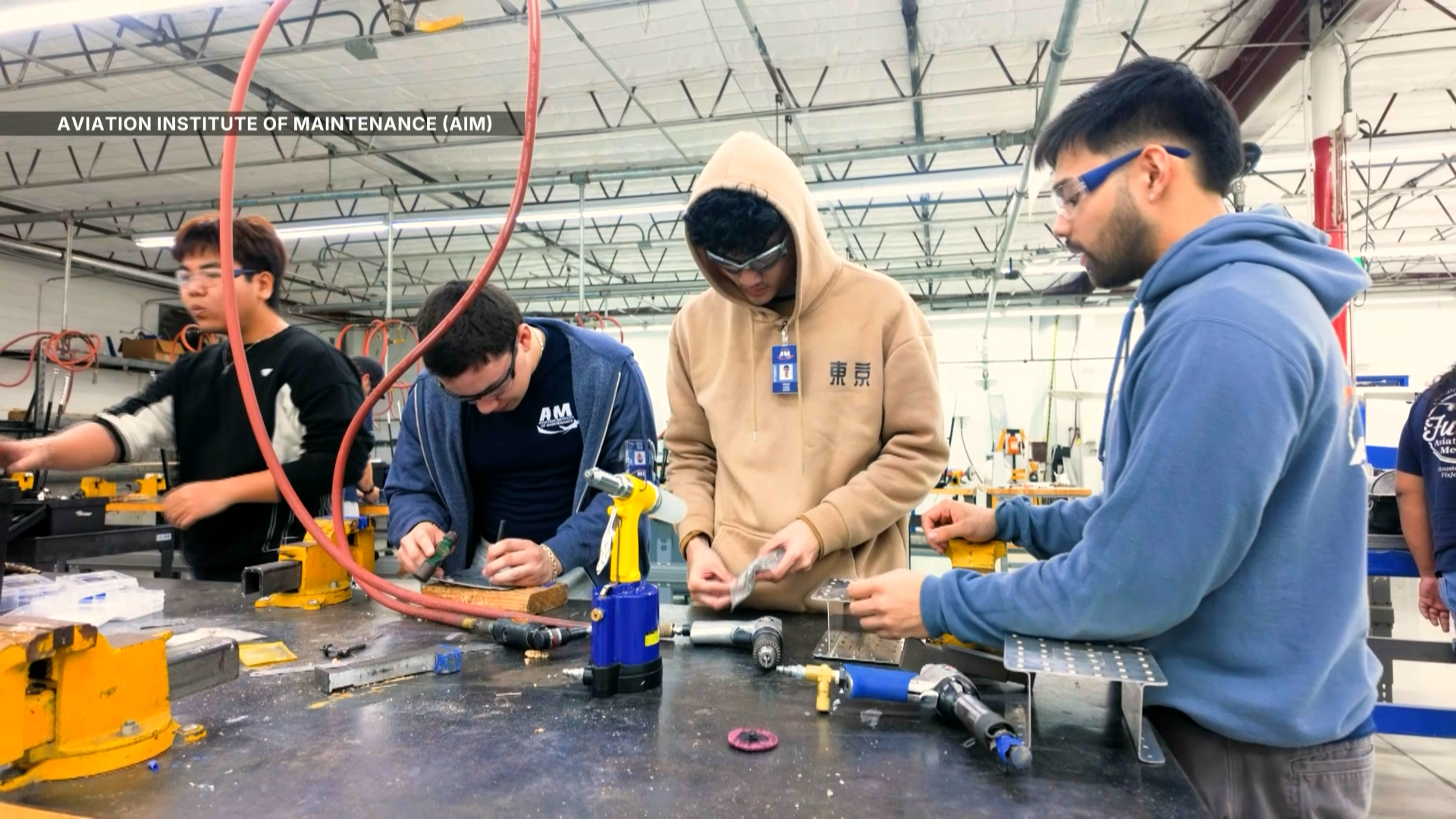


After trying college, Otavius Jackson decided a different path was right for him. The self-described "engineer nerd" has always loved math, and when he learned about aviation maintenance, the field immediately caught his attention.
"I love math. So aviation, aeronautics, avionics, whatever you want to say, it really spoke to me because that's something that I have a niche in," Jackson said.
Now studying at the Aviation Institute of Maintenance, Jackson expects to graduate in the coming months and said he's already preparing to apply for jobs. His journey into the trades started with an unexpected nudge from his mother.
"She saw an Instagram ad and she said, 'Hey, what about this?' And I was like, 'Oh, okay,'" Jackson said.
RELATED STORY | AI data center boom fueling a construction worker crunch
Jackson is entering the workforce at a time when employers across multiple industries are struggling to find enough skilled workers. From construction and electrical work to aviation maintenance, businesses say demand is outpacing the available workforce as older employees retire and major infrastructure and development projects expand nationwide.
According to a McKinsey & Company report, the aviation maintenance industry alone is expected to face a shortage of roughly 60,000 technicians by 2029.
Despite concerns among some young workers about artificial intelligence and a rapidly changing job market, Jackson believes his skills will remain in demand.
"I can already start applying to jobs and then they can see that, hey, I'm about to graduate in like two months," he said.
A growing shortage across the trades
The labor shortage extends far beyond aviation.
The Associated Builders and Contractors estimates the construction industry will need more than 450,000 additional workers next year to meet demand. Meanwhile, the National Association of Home Builders estimates the industry will require 2.2 million new skilled construction workers over the next three years to keep pace with growth, retirements and workforce departures.
Companies and nonprofits are expanding efforts to introduce young people to trade careers and build a stronger pipeline of future workers.
Google recently announced a program aimed at helping train 25,000 veterans for skilled-trade careers, including jobs such as master electrician and lead pipefitter.
The Home Depot and The Home Depot Foundation have also launched an initiative with a goal of providing 15 million introductions to skilled trades careers by 2032.
As part of that effort, the company created Skills Explorers, a free hands-on career exploration program for students, parents and educators.
"If we don't get more young people interested in the trades, then all of those training programs are still not going to fix the issues," said Erin Izen, executive director of The Home Depot Foundation.
Reaching students earlier
Industry leaders say exposing students to trade careers before they make decisions about college or other post-secondary pathways is critical.
"We want kids to be able to envision that and at least know it's a possibility for them at the time that they're making some of those key decisions," Izen said.
There are signs interest is growing.
According to an NAHB survey, the percentage of young adults interested in a construction trade career doubled over the last decade, rising from 3% to 6%. While that remains a relatively small share of young people, industry leaders see it as an encouraging trend.
RELATED STORY | Interactive: Why AI's building boom may delay other construction projects
Fraser Patterson, founder and CEO of the workforce platform Skillit, said another challenge is helping employers find workers with the right skills.
Patterson, a former journeyman carpenter and high-rise steel worker, said he often struggled to connect with employers despite having experience.
"We need to think very differently now that there's more constraint on that existing supply," Patterson said.
An alternative path with earning potential
Jackson acknowledges that the trades are not for everyone, but he believes they offer strong opportunities for people willing to learn specialized skills.
"Everyone is capable of doing the skills that are required to do these jobs," he said. "It's just what you have to do and what you have to put forth to be able to make that happen."
Industry advocates also point to the financial advantages. Career platform Technicians of America reports that many skilled trades jobs offer annual salaries ranging from $60,000 to more than $90,000, competing with or exceeding earnings from many careers that require a four-year degree.
Training programs can take anywhere from a few weeks to several years depending on the trade, and apprenticeships are often paid. Community college trade programs also typically cost far less than a traditional four-year degree, helping many students avoid significant college debt.
