

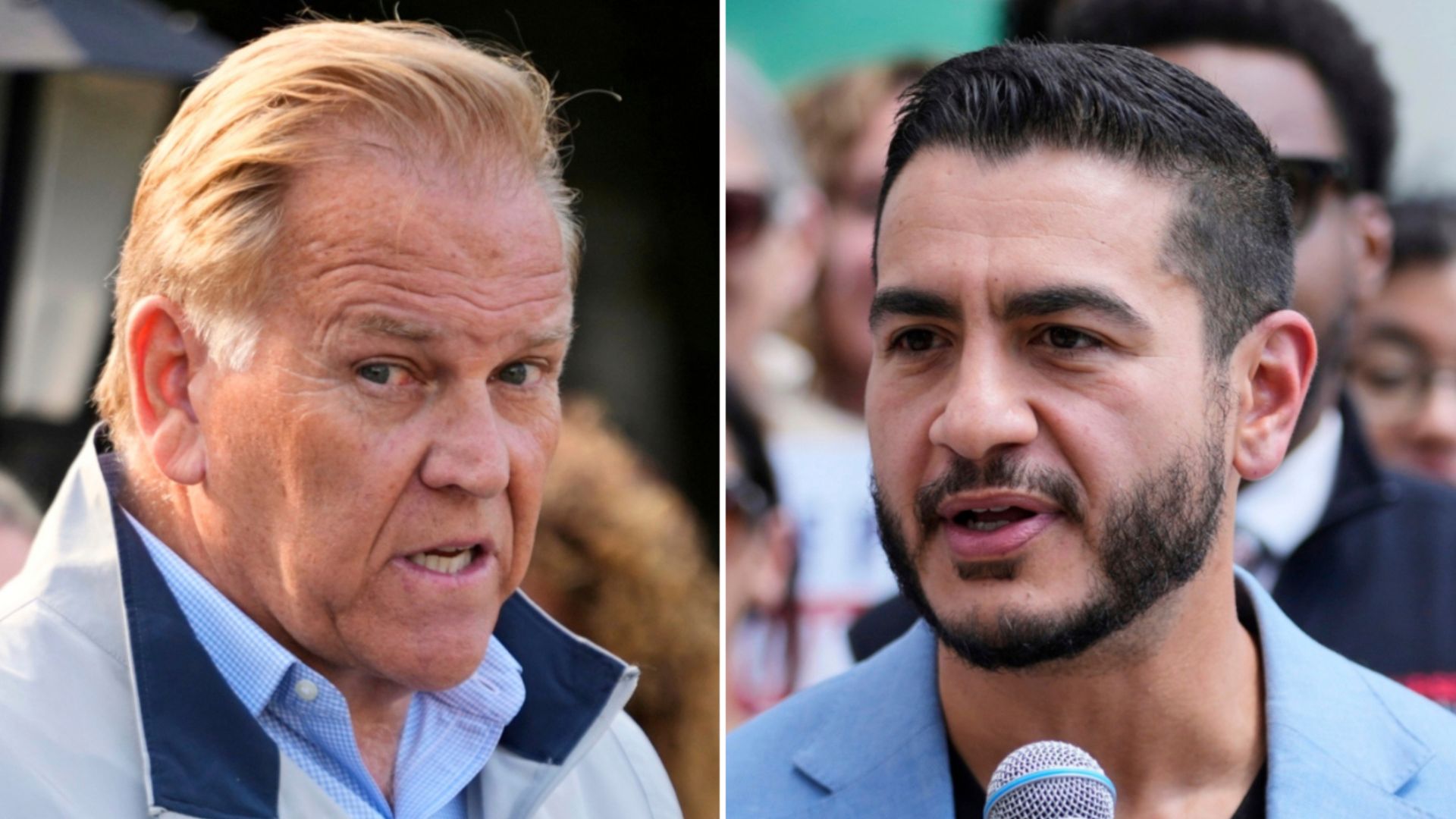


Abdul El-Sayed often talks about building a new and broad coalition of Michigan voters. A looming question in the state’s pivotal Senate race is whether he can keep the old one intact — particularly with the Black voters who are pivotal to any Democratic victory.
The Republican nominee, former Rep. Mike Rogers, has spent months working to make inroads with traditional Democratic constituencies that did not support El-Sayed, a progressive former public health official, in his bitter primary battle against Rep. Haley Stevens.
POLITICAL ANALYSIS | Battle for the control of Congress
And even though more than $280 million has been spent on television advertisements in Michigan since the 2026 midterm election cycle began, with billboards and campaign yard signs dotting the landscape alongside the fall colors, some political leaders wonder whether there is sufficient enthusiasm among Black voters for El-Sayed at this late stage.
“It only takes this much of Detroit to defect. It only takes this much of Flint to defect,” said the Rev. Charles Williams II, pastor of the Historic King Solomon Baptist Church in Detroit, holding his fingers about an inch apart to drive home his point. “If even a sliver of people don’t turn out, you run into a huge challenge in trying to get your candidate over that line.”
Holding the Democratic coalition
Michigan is crucial to Democrats’ hopes of the net four-seat gain the party needs on November 3 to win control of the Senate. If the party fails to retain the seat of retiring Democratic Sen. Gary Peters, its path to a majority would grow much more difficult — and would run almost exclusively through much redder states than this upper Midwestern perpetual political battleground.
El-Sayed defeated Stevens in the August primary by just 1 percentage point — a narrow victory fueled by his strong support among Arab American and Muslim communities, young voters and progressives in college towns.
But Stevens had clear strengths, too: Black voters in and around Detroit largely aligned behind her, as did Jewish voters who have long expressed deep concerns with El-Sayed, who is Muslim and a strident critic of Israel’s actions in Gaza.
IN CASE YOU MISSED IT | Poll: El Sayed holds slight edge in Michigan Senate race, but struggles with older swing voters
Rogers has made reaching those constituencies a central focus of his campaign in the race’s closing weeks, as he looks to assemble a coalition of voters more favorable to Republicans than in 2018, the last midterm election with President Donald Trump in office. That year, Democrats won four statewide races in Michigan, all by a range of about 7 to 9 percentage points.
At a Detroit Economic Club forum on Tuesday, Rogers bragged that he has “built coalitions that really are very untraditional for a Republican candidate.”
He pointed to plans to incentivize new home construction in Detroit, connect those construction efforts to high school apprenticeships, and eliminate “food deserts” in the city. He also said many Democrats have told him they fear the rising influence of democratic socialists within the party.
“We’ve spent a lot of time here in Detroit, Flint, Pontiac,” he said, listing cities with large Black populations. “I think if we’re going to get our state right, we have to have everybody included in its forward progress.”
In a bid to ease lingering Democratic doubts about El-Sayed, former President Barack Obama is set to visit Michigan, where he’ll attend a Saturday rally in Detroit with El-Sayed and the party’s nominee for governor, Michigan Secretary of State Jocelyn Benson.
Other prominent Black Democrats have visited Michigan in recent weeks, including former Vice President Kamala Harris, who held a roundtable focused on Black maternal healthcare with El-Sayed. Sen. Raphael Warnock of Georgia is also set to campaign with El-Sayed, as are several members of the Congressional Black Caucus.
“As much as he thinks he’s making inroads, folks are smart,” El-Sayed told CNN. “Mike Rogers is simply a rubber stamp on what Donald Trump wants. They understand exactly who Mike Rogers is.”
While conversations with Black leaders and voters across Detroit show widespread support for El-Sayed, quiet concerns emerged about whether questions pertaining to the nominee’s background could dampen support. Historic tensions between Arab American and Black communities also were raised as points of anxiety.
“In a close race, even a sliver of doubt about Abdul could lead to defeat,” one prominent Black leader told CNN, speaking on condition of anonymity to discuss concerns frankly. “And this race feels far closer than it should.”
El-Sayed mocks Rogers’ Black outreach
Even as prominent Black Democratic leaders in Michigan express concern about the Senate race, El-Sayed — who spent recent days campaigning in Michigan’s Upper Peninsula, a sparsely populated region where he hopes his populist pitch will chip away at the GOP’s traditionally strong margins — is downplaying and even mocking Rogers’ efforts to win over Black voters.
At a campaign stop in Flint, a majority-Black city, a few hundred supporters turned out for an El-Sayed rally on Sunday afternoon. Only about a dozen members of the audience who packed into a large hotel conference room were Black, which was striking for a Democratic campaign event two weeks before the election.
As he spoke to reporters afterward, El-Sayed said he saw no reason for concern.
“Look, one of the hardest things about this economy is that too often folks are having to work multiple jobs and having to work on weekends,” he told CNN. “We know because of exactly the policies architected by folks like Donald Trump, that falls hardest on Black folks.”
He was joined at the rally by Democratic Rep. Ayanna Pressley of Massachusetts, one of several Black members of Congress who have traveled to campaign alongside him.
“We feel really strong about the relationship we’ve built and will continue to build,” El-Sayed said of his outreach to Black voters.
When asked about the Rogers campaign opening a storefront office on Livernois Avenue in Detroit as part of its effort to win over Black voters, El-Sayed answered with a laugh.
“I saw he opened a cute little office in Detroit where he brought all his friends from the suburbs to come clap him in. It was nice, yeah,” El-Sayed said. “He’s got no actual message for anyone who is struggling to make ends meet.”
RELATED STORY | Alexandria Ocasio-Cortez tours for Michigan progressive Abdul El-Sayed in close Senate race
Marcia Turner, who attended the Flint rally, said she was optimistic about El-Sayed, who she called “the right person at the right time.” But even her kind words underscored a history of some tension between the Black and Arab communities of Michigan.
“I love that he’s running,” Turner said. “I think people are looking past his religion and seeing him as a man who wants what we want for our children and grandchildren.”
Rogers steps ‘out of his space’
Naura Evans, a teacher and mother of two from Sterling Heights, is a proud Black Republican. She appears in a television commercial, saying: “I voted for Barack Obama, but this year, I’m voting for Mike Rogers.”
She said she grew up in a Democratic family but has become more conservative since her 2008 vote for Obama. She said she thinks schools and neighborhoods haven’t improved under Democratic rule and believes in Rogers’ plans for both.
She said she feels that Democrats have taken Black voters for granted over the years, so she spends time going door-to-door in Warren, Troy and Sterling Heights, trying to persuade voters to join her in supporting Rogers.
“It’s very important that we elect the right people,” Evans said. “As Blacks in our community, we show that our vote matters. We’re not just giving the vote away.”
She said the Rogers campaign should get credit for opening an office in Detroit.
“I’ve seen Mike Rogers definitely step out of his space and go into the Black community,” Evans said. “I think it’s practical and I think it’s also symbolic that he cares about Detroit. He could have opened an office anywhere and he chose Detroit.”
She dismissed one of the biggest pieces of criticism she hears from Democrats about Rogers — that he would be a rubber stamp for Trump.
“This is not a presidential election, it’s a senator’s election, and ultimately Mike Rogers will be the one making his own decisions,” Evans said. “I’m sure that his decisions will not be influenced by someone else.”
‘His culture is different’
Quentin Murray listened to the full slate of Democratic candidates speaking at a carpenters’ union hall on Sunday in Detroit. He said he was just beginning to learn more about El-Sayed’s candidacy but liked what he heard.
“I like what he’s bringing to the table — something new, something different,” said Murray, a carpenter. “His culture is different, but when you see somebody like that, it’s good to know that we have the same interests and values.”
Yet even in his praise, Murray casually brought up El-Sayed’s culture, which has been at the center of the campaign in bitter attack ads about his upbringing and beliefs.
El-Sayed, a doctor and former public health official whose parents immigrated to the US from Egypt, was born and raised in Michigan.
At nearly every campaign stop, he briefly explains his family history and pushes back at some of the racially charged conversations about his name, which has been regularly belittled by Trump, who has taken to calling him “Mohammed Abdul El-Sayed.”
Rogers has attempted to connect El-Sayed to the Muslim Brotherhood — which El-Sayed has denounced — and cast him as sympathetic to interests connected to Islamic terror. The GOP has pointed to old tweets from his sister describing El-Sayed’s birth mother’s activism with the Muslim Brotherhood while she was in college in the early 1970s. In a recent debate, Rogers also pointed out that El-Sayed’s mother worked for the Islamic American Relief Agency, a nonprofit that the Treasury Department in 2004 designated as an organization supporting terrorism. El-Sayed was primarily raised by his father and stepmother in Michigan.
“My name and my faith are not the reason you can’t afford your gas. My name and my faith are not the reason you cannot afford your groceries,” El-Sayed told supporters in Flint. “My name and my faith are not the reason you can’t see a doctor. I mean chances are if you’re seeing a doctor, they might actually have my name and my faith.”
A progressive’s bid to win over moderates
Charity Dean, who owns a Detroit coffee shop and is president of the Michigan Black Business Alliance, said she has been pleasantly surprised by the enthusiasm for El-Sayed in her city.
“Detroit is more conservative than folks would think — a lot more moderate,” Dean said. “I think his campaign has done a phenomenal job of really busting out of the box and saying, ‘Are you happy with how things are now? Are you happy with forever wars?’”
Since finishing a distant second in Detroit in the August primary, Dean said, El-Sayed has listened to voters — supportive and skeptical ones alike — and has worked to build a campaign to win them over.
“One of the things that’s gained him a lot of ground is his ability to respond to criticism and questions,” Dean said.
While Dean said she has seen many signs that Rogers is trying to expand his outreach to Black voters, including television ads and opening an office in Detroit, she questioned whether the Republican nominee’s policies followed suit with the actions of his campaign.
“Everything should be taken seriously. This is not a year where we take anything for granted,” Dean said, noting that she is carefully watching what the Rogers campaign is doing. “He seriously wants to win their vote, but he doesn’t want to make life better for Black people. That’s what really matters.”
The-CNN-Wire™ & © 2026 Cable News Network, Inc., a Warner Bros. Discovery Company. All rights reserved.
