



HELENA — In 2010, the U.S. Supreme Court issued its Citizens United decision, ruling that corporations have a right to spend money on political ads as long as they don’t coordinate directly with a campaign. In the 16 years since, there’s been an explosion in those independent expenditures, including in Montana elections.
Frustration over that political spending, and the mailers and TV ads that go along with it, is what the supporters of Initiative 194 say they’re responding to.
“The funding source of the majority of those mailers comes from largely corporations, or what we call ‘artificial persons,’” said Russ Cleveland.
Cleveland, who was a Democratic candidate for U.S. House earlier this year, is now the executive director of partnerships for The Montana Plan, the committee backing I-194. In recent weeks, he’s been going around the state, hosting events where he makes the case for voters to support the measure.
(Watch the video for a closer look at I-194.)
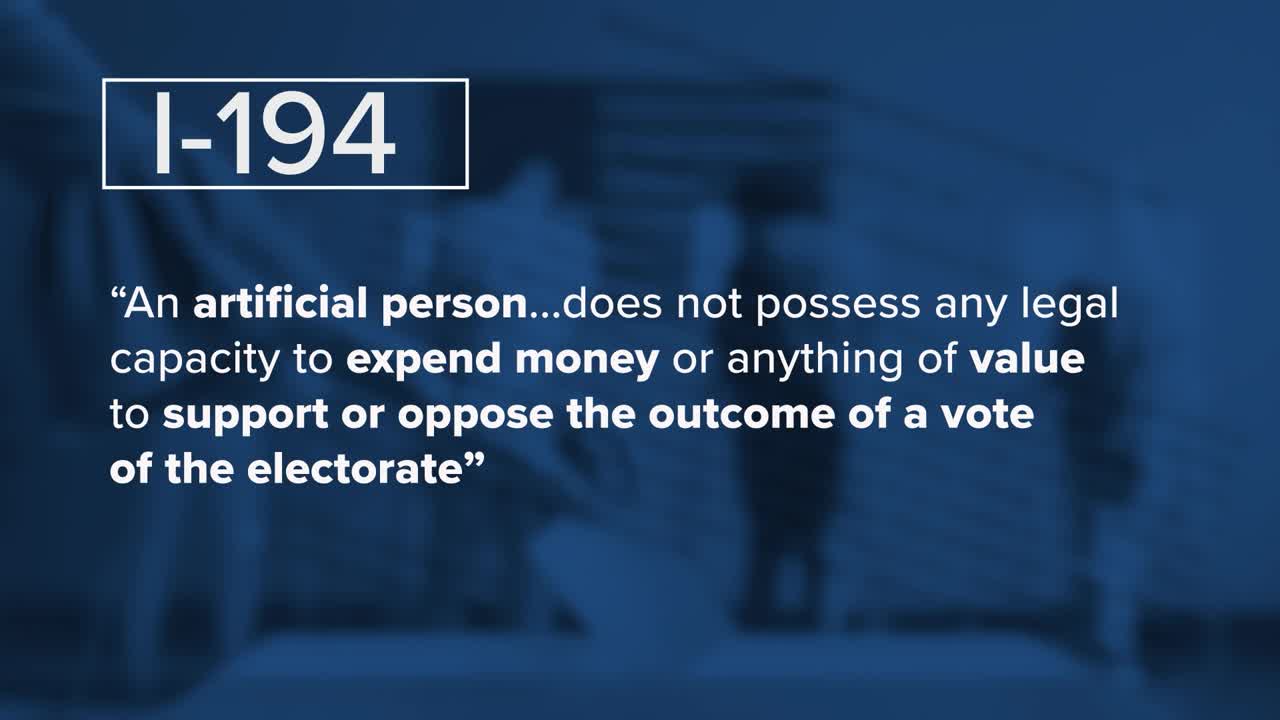
If passed, I-194 would say an artificial person – like a corporation or a labor union – “does not possess any legal capacity to expend money or anything of value to support or oppose the outcome of a vote of the electorate.” Any entity that doesn’t comply “forfeits all charter privileges.”
While the language of the initiative is complex, supporters say the goal is simple: to discourage corporate money from being used for election expenditures. Cleveland says political spending can still happen through registered political committees – but there will be greater transparency if donors contribute money under their own names.
“This is simply a change in accounting,” he said. “There's nothing stopping you as an individual from continuing to contribute, whether it's actual dollars or an in-kind donation.”
I-194 is based on a new legal interpretation. Sponsors argue the state has the authority to set what powers corporations have, so Montana can simply decide those powers don’t include spending in elections.
The most vocal opposition to I-194 has come from business groups, like the Montana Chamber of Commerce.
“We're frustrated by the election process, we're frustrated by the amount of money that is being spent in our elections today – this doesn't solve it,” said Chamber President and CEO Todd O’Hair.
O’Hair says the proposal would keep businesses from being heard, but it wouldn’t prevent wealthy individuals from spending heavily.
“The millionaire and the billionaire class will not be affected whatsoever,” he said. “They will be able to spend freely in Montana's elections by silencing Montana's small- and medium-sized businesses.”
O’Hair said most Montana businesses are incorporated, and it often isn’t “practical or feasible” for those corporations to redistribute funds from the business to the shareholders.
Cleveland believes I-194’s impact on businesses is overstated.
“Your average small business doesn't have a budget for political spending,” he said. “So they're really protecting those big five or six companies that do have a several-million-dollar budget to do so.”
One major question: Will I-194 survive in court, where it’s almost certainly headed if it passes? The Montana Chamber, local chambers of commerce in Billings and Kalispell, and other trade organizations already joined in litigation earlier this year, arguing the initiative was unconstitutional and should be kept off the ballot.
Meanwhile, Hawaii passed a similar law to I-194 through its legislature this year. That law was immediately challenged, based on the finding in Citizens United that corporations were entitled to participate in political speech.
“Trying to figure out ways to get around that has been a challenge for anyone,” O’Hair said.
Cleveland said, in talking to voters about I-194, the legal questions are some of the biggest topics.
“People always ask, how will this hold up in court, is this legal?” he said. “It's educating them on the Tenth Amendment and on the state's ability to revoke or alter corporate powers at any time – that's an existing framework we're just utilizing here in Montana.”
Some opponents of I-194 have questioned whether supporters of The Montana Plan are adhering to their own principles of transparency. The Transparent Election Initiative, the organization that originally launched the plan and is now promoting it in other states, is itself a 501(c)(4) nonprofit that does not need to disclose its donors. TEI has passed on roughly $240,000 to The Montana Plan committee as of August.
While TEI does not have to disclose its donors, The Montana Plan as a registered state political committee does report donors who contribute more than $50. In addition, TEI has released quarterly reports listing the first names and last initials of all donors and the full names of those giving more than $800. In April, May and June, the largest contributions were $150,000 from Reid Hoffman, a venture capitalist from California, and $100,000 from Samantha Walton, a philanthropist from Chicago.
The Montana Chamber of Commerce has contributed to a political committee opposing I-194, Montanans for Free Speech. The organization’s campaign finance documents don't show donations as of August but do show two main expenditures: roughly $9,000 for letters encouraging people who signed the petition to get I-194 on the ballot to remove their names, and about $45,000 for polling.
On Thursday, MTN will continue our look at Montana’s statewide ballot measures with Constitutional Initiative 132.
Read the full text of Initiative 194 here.
