



HELENA — Around Montana, you’ve likely seen signature gatherers, asking people to sign petitions to get proposed ballot measures before voters this year. Now, the deadline for getting those signatures is fast approaching – but the sponsors of one measure believe they’ve already done enough to qualify.
(Watch the video for more on where three proposed ballot initiatives stand now.)
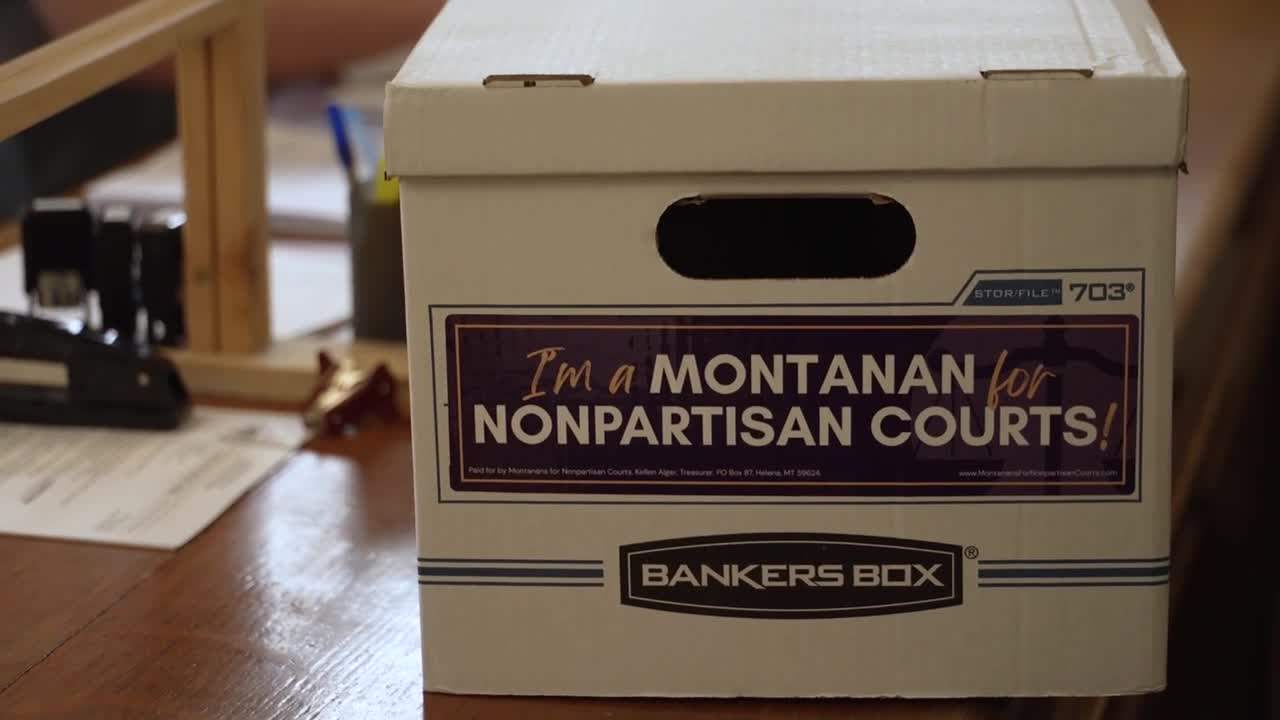
Montanans for Nonpartisan Courts, the committee behind Constitutional Initiative 132, turned in some of their final signatures to the Lewis and Clark County Elections Office in Helena Wednesday. They say they’ve gotten more than 100,000 signatures – well over the 60,241 they’d need to get on the ballot.
“We got so much positive feedback out in the field from volunteers who are gathering and saying that to a lot of voters, this is just a no-brainer,” said Caitie Butler, a spokesperson for MNC.
However, that number could still change. Election officials will be checking each signature to make sure it’s valid – that it’s from a registered voter, that it was turned in to the correct county, and that it matches the signature on file. In addition, ballot measures need a minimum number of signatures in a specific number of state legislative districts, to ensure the support isn’t coming from just one part of Montana. The final number of accepted signatures is typically significantly lower than the initial amount supporters turn in.
Butler says MNC used both volunteer and paid signature gatherers and got people to sign in all 56 counties.
“We feel very confident that we have well cleared the threshold for qualifying for the ballot,” she said.
Montana has elected judges without political party labels since 1936 – though in the last three legislative sessions, lawmakers have debated introducing partisan elections. CI-132 would add a section to the Montana Constitution requiring judicial elections to remain nonpartisan. If voters pass it, it would prevent the Legislature from switching to partisan elections without another voter-approved amendment.
“We're confident that this is a popular initiative, and now it's just our job to communicate to voters across the state between now and November,” said Butler.
Meanwhile, it appears there will not be a ballot measure this year to reform Montana’s property tax system. State Sen. Wylie Galt, R-Martinsdale, announced this week that he was suspending his effort to qualify Constitutional Initiative 134 for the November election. That measure would have amended the state constitution to limit how much local governments can increase the total taxes that property owners pay.
CI-134 got a late start, with Galt only submitting it in March. He told MTN he thought supporters could have gotten close to qualifying the measure, but time was running out. Anyone wanting to get a ballot measure before voters in November has to turn all their signatures in to county election offices by June 19.
“Everyone knew it was an ambitious goal, and we felt confident, but the writing was becoming clear – we just didn’t quite have enough runway,” said Galt.
Galt said he’s heard questions and concerns about the idea in CI-134, but also interest. He said he wants a cap on local taxes to be part of a broader discussion about property tax relief during the upcoming 2027 legislative session.
“The cap definitely isn't the end-all, be-all to solving the property tax problem, but I do believe that it’s an important part that we really need to look at,” he said.
Matthew Monforton, an attorney from Bozeman, submitted his own property tax ballot measure: Constitutional Initiative 130, which aimed to slow property tax growth by capping property valuations. He told MTN Wednesday that his proposal won’t get enough signatures to get on the ballot either, and that it’s become very difficult to qualify an initiative without a large campaign and paid signature gatherers.
Monforton, who submitted his proposal last year, said he saw his plan as the only one that would have created significant property tax relief.
“If Sen. Galt had been serious about reforming property taxes through a ballot measure, he should have supported ours,” he said.
