

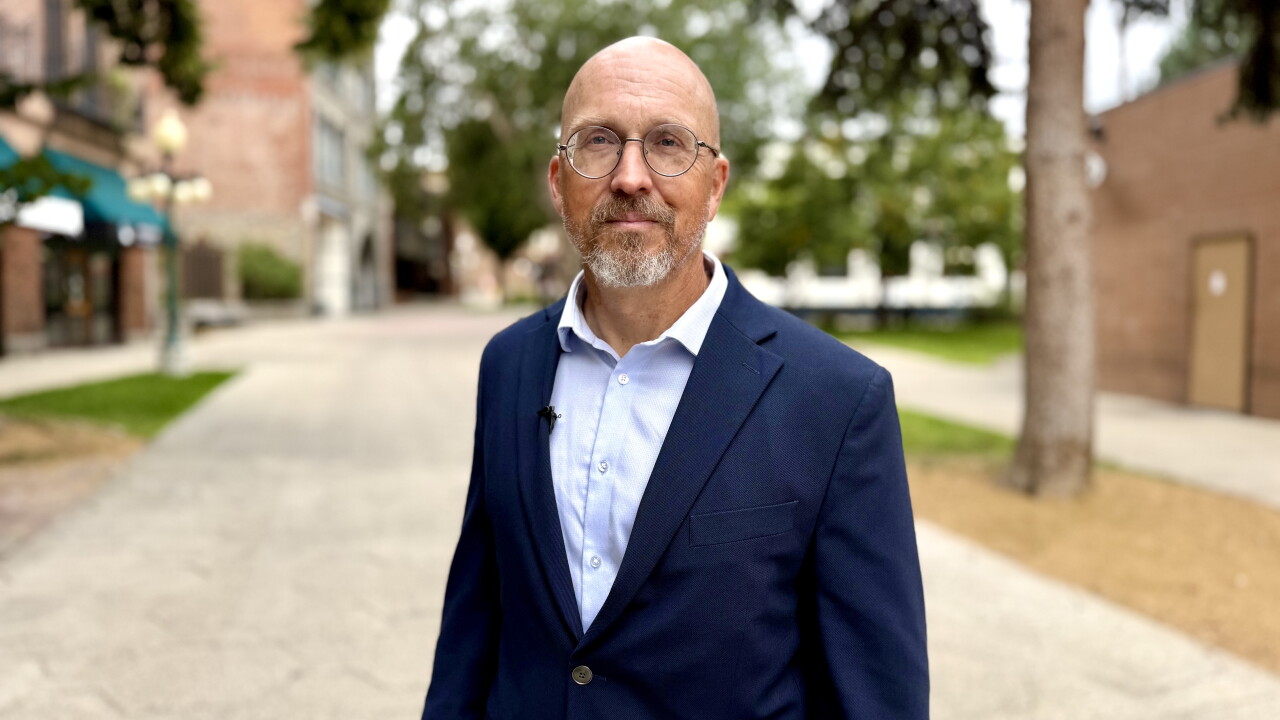

HELENA — Democratic U.S. House candidate Brian Miller has been working at the law firm Morrison, Sherwood, Wilson, and Deola in downtown Helena for years. He says, even as he makes his daily walk to the office – sometimes accompanied by his dog Walter – he’s listening to what’s on people’s minds.
“If people don't want to talk politics, I'm not going to force it on them,” he told MTN. “But if we start talking – a lot of times if I'm out somewhere, I'm talking about data centers – and so if people want to talk about it, then I'll say, ‘Hey, just so you know, I've made this my issue.’ That's usually how most of the conversations start these days.”
(Watch the video to hear more from Miller.)
Data centers have indeed become central to Miller’s campaign, as he’s called for stricter regulations on new construction and accused the industry of not being transparent about its plans and the impacts they could bring. He’s also the attorney for Yellowstone County Voices, a citizens’ group that’s trying to bring a ballot measure to require voter approval for data center projects in the county.
“When I started out, I was not into this – and I actually had people telling me I should pay more attention to it, and I kind of blew them off,” he said. “But eventually I saw the issue, and the reason why I've made it my top issue is because so many people are concerned about it, and the data center industry is really trying to make a play on Montana right now. So we've got a really critical window to try to get control of that.”
Miller’s work with the Yellowstone County group is just one example of how he’s taken on other projects during his congressional campaign. Earlier this year, he provided legal advice to a woman who accused fellow Democratic candidate Jonathan Windy Boy of misconduct. Last month, he filed a lawsuit challenging independent candidate Michael Eisenhauer’s place on the general election ballot; he dropped the case after missing a hearing, later admitting he had taken on too many responsibilities.
“It does take away from the campaign,” Miller said. “But I'm the kind of guy who’s like, if I see something like that and if no one else is doing anything, I'm going to try to do something about it. And these are important issues.”
Miller, 54, grew up in Florida and first came to Montana as a “jammer bus” driver in Glacier National Park. In his 30s, he went to law school, and after clerking at the state Supreme Court, he went into private practice. He’s handled a wide range of litigation, from civil law to criminal cases to family law.
“I'm just a regular guy; I'm not a millionaire,” he said. “I’ve got two kids. My kids are in their 20s. And I tell you, people in that age range and younger, they don't feel very hopeful about the future – and that's not good.”
National election analysts have projected the 2nd Congressional District, which covers much of central and eastern Montana, as solidly Republican. U.S. Rep. Troy Downing won over his Democratic opponent by more than 30% in 2024.
Miller’s campaign is largely a one-man operation, though he has volunteers supporting him. He acknowledges he’s raised little money, and he says Democratic leaders have been neglecting the 2nd District.
“They don't even mention – it's like I don't even exist,” he said.
Miller admits defeating Downing would be a “longshot,” but says Democrats need to demonstrate they’re committed to representing rural areas like this district.
“Things just might get so bad, because of all the stuff that we're seeing out of the federal regime, that people might just – and I've said this before – they might do the unthinkable and vote for a Democrat out here,” he said. “I mean, it might happen.”
See Brian Miller’s extended answers on specific issues:
Should the federal government be putting more restrictions on data centers?
“I think the federal government, though, really needs to empower the states against them, I think the states need to control it. I'm very skeptical of regulations that would come out of Washington, D.C.; I think they would be slanted towards the data center industry too much. So I want to see state sovereignty. If there was a law that said we're going to respect state sovereignty and we’re going to respect local control, that's something that I would get behind.”
Should local communities have an absolute right to say no to construction in their area?
“Yeah, it's a two-thirds vote, is what we're talking about in Yellowstone County, and I think that that is what you need to do – because that will force the data center industry to do something which they don't want to do, which is put all their cards on the table. Right now, I'm the attorney for the guys down in Yellowstone, as you know, and the data center industry, the Quantica people, are making up numbers about water usage. They said 20,000 gallons – completely fictitious number. You can't know how much water a data center uses until you see the schematics and you know all the details about how many server racks they're going to have, which ones are going to be evaporative, which ones are going to be closed-loop. We're in the sixth year of a drought; we can't be playing game with our water. It really frustrates me that the data center industry does not respect our farmers and ranchers enough. So I think at this point – and given surveillance concerns and everything else – that's the only way to rebuild any sort of trust at all is to have that vote.
Are there actions Congress could be taking to help improve the supply of accessible, affordable housing in Montana?
“Absolutely. There's a couple of things that I think we could do. One of the big ones is to make it easier, first off, to do land trusts. Land trusts are a way that people can, with a smaller down payment, get into a house – and they don't technically own the land, the land is owned by everybody that's there, but they still have the right to sell the land when they when they are ready to move, and they still make a profit of it, just not as much. But what they do get is they get stable payments every month. I was just in Billings last week, at a mobile home park where they were raising the rents like $175 a month on people for no good reason, and making up. So one piece of legislation that I do want to see us do at a federal level is to put some limits on those kind of rent increases at mobile home lots, because so many people, especially in Montana, live in mobile or manufactured home parks – and especially people, seniors on fixed income, vets on fixed income. So we absolutely have to do something to stabilize that, and that is federal legislation I would support.
Are you supportive of the more aggressive federal immigration enforcement we’ve seen under the Trump administration?
“I don't support the mass deportation policy. I do support securing the border. Trump did secure the border, and we do need to have a secure border. I did not support the Biden-Harris open border policies. I thought it was an absolute disaster, and I was very frustrated with that. But the mass deportation policy – it's having enormous consequences on us. It's not good. I want to see us focus on actual criminals and get actual criminals taken out of the country. For people that are here that came in, perhaps they snuck in or something, here's what I want us to do: Let's make contact with those people and kind of put them on a probationary status. Let them know that we are aware they're here and make sure we have their information. If any of those folks do anything that they shouldn't be doing, then, yeah, you got to go. But if they are working and doing what they need to do, let's do that so we keep tabs on people, and then let's have Congress work on rational immigration reform. The last president that did immigration reform was Ronald Reagan, and I think we need to get back to the Reagan approach on immigration.”
Do you think the Trump administration’s tariff policy has been successful?
“No, I've opposed them. This was one of the first things that I put on my website back in April of last year: The tariffs were unconstitutional, the Supreme Court held that ruling. These tariffs are a disaster, and here's why they were a disaster: Tariffs can be helpful if you are using them in the context of an actual negotiation, because countries have different, internal policies on their markets. In the United States of America, for instance, we subsidize our oil industry a lot – we do a lot of that. In other countries, they may do other things. So you do have to use tariffs to sort of have a balanced agreement. But Trump doesn't understand how those work in negotiations, so his have just been destructive. They've destroyed – I've talked to farmers out in more ag-heavy parts of this district that had to pay thousands more dollars for stuff in Canada. A lot of our guys had deals across the border with Canada that had been completely torpedoed because of Trump. So Downing should have done something; he should have stood up to him on this.”
Should anything be done to help Montana businesses who say they’ve been harmed?
“They should give them their money back; they should immediately get rid of all the tariffs. I've said this a bunch of times: If I get elected, one of the first things I am going to do is take a group of farmers and ranchers and businesspeople and go across the border into Canada, and apologize to the Canadians for what a jerk Trump is being. That's not us; we don't want to be at war with our friends to the north – they're actually a lot like us. I just think it's shameful and pitiful that Troy Downing has not done anything to stand up for our farmers and ranchers and say, ‘That's not who we are.’ He should be doing this, but I'll do it If the people put me in there to replace him.”
Do you want to make any changes to the tax policy Congress passed in the “Big Beautiful Bill” last year?
“Yeah, it's a disaster. I just read an article the other day, for instance, how they did this exemption for large businesses, for capital improvements. We just learned the other day that Amazon and Meta and all these companies that are building these huge data centers and making huge, huge profits are using it. All these capital improvements are leading to huge tax write-offs, which means the taxes we're getting from these companies, that are making more money than ever, is reduced. What always happens in our tax policy, especially under Trump, is that the regular people, we always get hammered, and it's the wealthy people that never pay their fair share. We absolutely have to reverse that. Downing voted for this thing in the “One Big Beautiful Bill”: They gave a $1 trillion tax cut to the top 1% and cut $1 trillion from Medicaid. I don't see how you sleep with yourself when you do those kinds of things.”
Do you want to see further changes to eligibility requirements for benefits like Medicaid and SNAP?
“We need to make sure those aren't being abused, but the problem, like with the work requirements in Medicaid, is that it's going to lead to a lot of paperwork and problems. I've talked to people, and I have a real problem with what I've heard, that people are having to send their protected health information to Washington, D.C., and having to give up their HIPAA rights. So now, in order to get Medicaid, your personal medical information is going to be in some AI database in Washington, D.C., that anybody can search. So the solution to dealing with fraud in programs like Medicaid and these others is to hire more fraud investigators. I mean, it's human nature: Any time you have a pile of money sitting around, there's always going to be people that abuse it. But it doesn't mean that you cut the programs, because most of the people legitimately need the services.
Social Security is projected to be unable to pay full benefits by 2032. How should Congress respond?
“Congress has been kicking the can on this thing for a long time. There's a couple of different things that that we need to look at doing. It needs to be a conversation; you need to have a good faith conversation and quit lying.I'm really concerned that people like Troy Downing want to take Social Security and destroy it – and I think he probably does, because he's doing the same thing to Medicaid right now, he's cutting it to destroy it. So one of the things that we have to look at is raising some of the contribution rates. We also need to look at doing things like means testing. There's a list of different proposals out there as ways to stabilize that. But if we don't take this seriously, seniors in a few years are going to see a 22% reduction in their rates in Social Security. The good news is the money is there; it's just that we're letting the wealthy people, the billionaires, the corporations keep more and more money, have more and more power – and then we're destroying things like Social Security, which is what people like Troy Downing want to do.”
What role, if any, should the federal government play in regulating abortion?
“It's up to the states now. The Supreme Court decision put an end to that, and that’s where it is, is with the states – for better or for worse, that's what we're dealing with now.”
Do you support the Trump administration’s decision to repeal the nationwide Roadless Rule?
“Absolutely not. We barely have any wilderness left as it is, and all he’s going to do – what Trump wants to do with that is open up so those data centers can put in there. He's already said that you're backward and poor if you don't want a data center. All the stuff he's doing is so he can put more data centers in everywhere. So no, absolutely I'm against that.”
Do you want to see changes in how the federal government manages federal lands?
“It's always a complicated question because you have federal lands, you have state lands. You do have to have resource extraction – we need rare earth metals, we need timber, especially now that Trump is destroying our relations with Canada – that's where we got a lot of our timber. So because of Trump now, we're going to have to figure out something. What I think we always need to do in these situations – because there's been some success in this – is you've got to get people around the table talking and figuring out. You can't ignore the environmental impact – we need clean air, we need clean water. On the other hand, you can't ignore the need to have resources – until AI invents some 21st century way to just make things like in Star Trek, we're going to need to have things like resources. But you have to look at it as a case-by-case basis.”
How do you think the U.S. should be approaching the ongoing conflict in Iran and the Middle East?
“I've said since Day 1, we’ve got to get our gear out of there. We are the reason why there's a problem in the Middle East – it's us. Look at all of the problems that have occurred in the Middle East in the modern era: They're all because they don't want us there. There was an argument to be made that we needed the oil. That argument doesn't matter; that's not a valid argument. We produce more oil than we need. The Iranians have been pretty clear, and all the other countries in there, if we get out, that whole thing's going to calm down, the Straits are going to open. So I will not vote for a penny for the Defense Department until we get our gear out of there.”
