

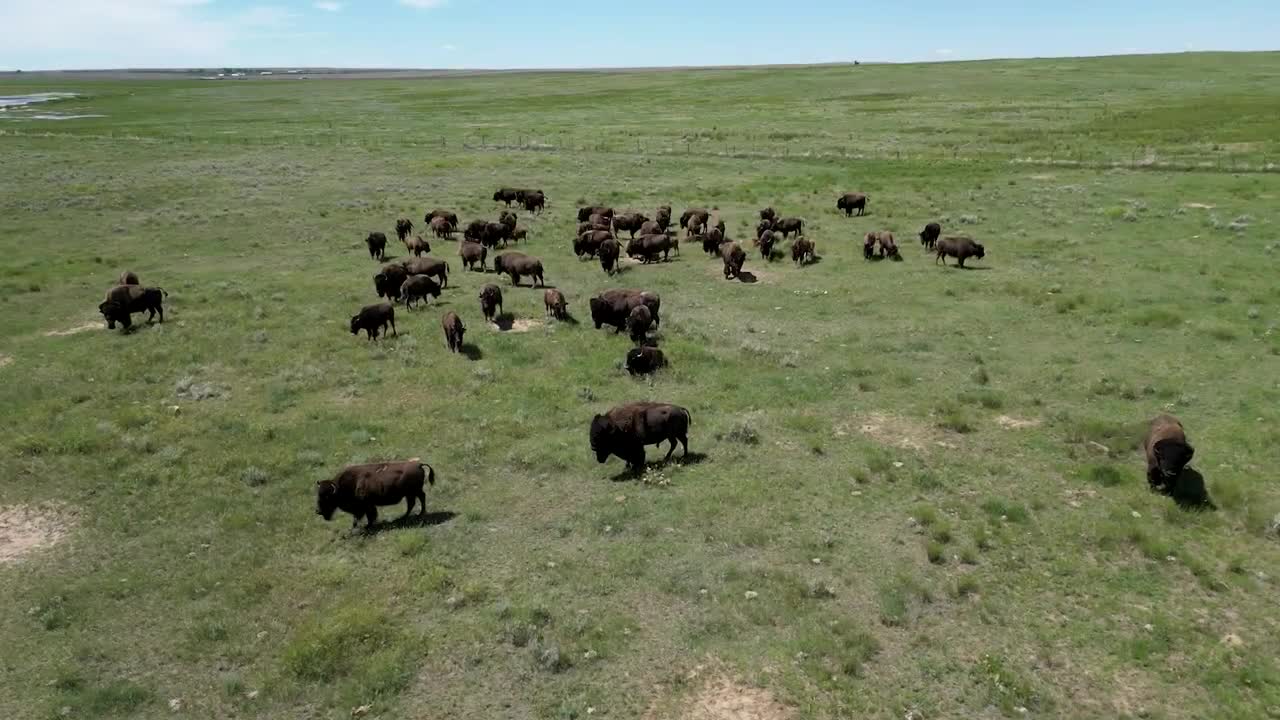


ROCKY BOY — Five years ago, the Chippewa-Cree Tribe welcomed 11 buffalo back to tribal lands for the first time in nearly 30 years.
Today, that herd has grown to 64 animals grazing across 2,000 acres. But for the people who care for them, the project has never been about numbers alone.
(WATCH: Five years after buffalo returned to Rocky Boy, the herd continues to grow)
"It's about restoring that connection," said herd manager Wyatt Caplette.
Caplette grew up on the Rocky Boy Reservation hearing stories about buffalo and their importance to the Chippewa-Cree people. But like many others in his generation, he never saw them on the landscape.
"When I was growing up, there was no buffalo herd," Caplette said. "You hear the stories. You hear the history of our tribe being a buffalo tribe, but not seeing them on the land."
That changed in 2021, when the tribe partnered with the American Prairie and the Confederated Salish and Kootenai Tribes to establish Rocky Boy's herd with 11 animals.
The herd has since expanded through successful breeding and additional acquisitions, while the grazing area has grown from 1,200 acres to 2,000.
For Caplette, one of the biggest lessons has been learning to trust the animals.
"The biggest thing I had to learn was just to let buffalo buffalo," he said. "You don't have to help them calve. You don't have to help them feed in the wintertime. You don't have to build them shelters. It's hands off as much as possible.”
Managing the herd also means navigating tribal, state and federal regulations, along with differing views on how buffalo should be managed.
"The biggest challenge is politics," Caplette said, noting the tribe often balances competing approaches to buffalo management. "You have the federal government's ideas of managing buffalo. You have the state's ideas of managing buffalo... and then you have the tribe's ideas of how buffalo should be managed."
Every tribal nation in Montana manages its own buffalo herd, but Rocky Boy's remains the state's youngest and smallest. Even so, tribal leaders say it plays an outsized role in preserving Chippewa-Cree culture while supporting the community.
Each year, the tribe harvests several buffalo, providing healthy meat to community members and helping strengthen food sovereignty.
"The entire reason why we do our harvest is to provide our community with buffalo meat, to help establish our tribe's connection to these animals again," Caplette said.
The project also welcomes school groups, visitors and researchers to the ranch, where they learn about the buffalo's cultural significance and their role in maintaining healthy prairie ecosystems.
Ken Morsette, president of the Rocky Boy Buffalo Project Board, has been involved with the project since the beginning. He still remembers watching the first buffalo run onto the prairie in 2021.
"When we released them, hearing them hoof beats and the cries and the happiness as them hooves ran across the prairie, it just brought such joy," Morsette said.
Looking ahead, the tribe's long-term vision is ambitious: a herd of 700 buffalo spread across 70,000 acres.
Caplette acknowledges that goal is decades away, but says the work continues one step at a time.
For Morsette, the future of the project depends just as much on people as it does on buffalo.
"We need more younger people to take interest," he said. “I won’t be around forever; the creator could take me tomorrow. We need more people like Wyatt to be the roots for Rocky Boy."
