


BILLINGS- Past presidential visits to Billings have come with layers of security and logistical coordination that most people never see.
The few people in Billings who have had that experience described Wednesday what it really takes, including bomb-sniffing dogs and background checks on every person.
Watch older footage of presidential visits below:
When a president visits Montana, the work starts long before the motorcade arrives.
Bill Dutcher spent 40 years at MetraPark, helping prepare the venue for all kinds of guests, including Presidents Ronald Reagan and Donald Trump.
"You really spend about five days with them," Dutcher said.
The process begins quietly. There are no public announcements and no press releases.
"It starts with a phone call. It's hush, hush," Dutcher said.
The White House advance team and the Secret Service each play distinct roles. The advance team focuses on checking logistics like television camera angles and décor. The Secret Service goes much deeper, looking into every person in the building and sweeping every room.
"No stone is left unturned," says Dutcher. "Every building plan, anything electrical, plumbing...anywhere anybody could hide."
At MetraPark's 189 acres, that means a thorough sweep of every corner of the property. This includes old barns and grandstands, all of which occurs long before any president sets foot on the grounds.
"All of a sudden there's teams of dogs," Dutcher said. "There was a hundred soldiers going through all of the grounds."
Hotels in Billings have followed that same drill.
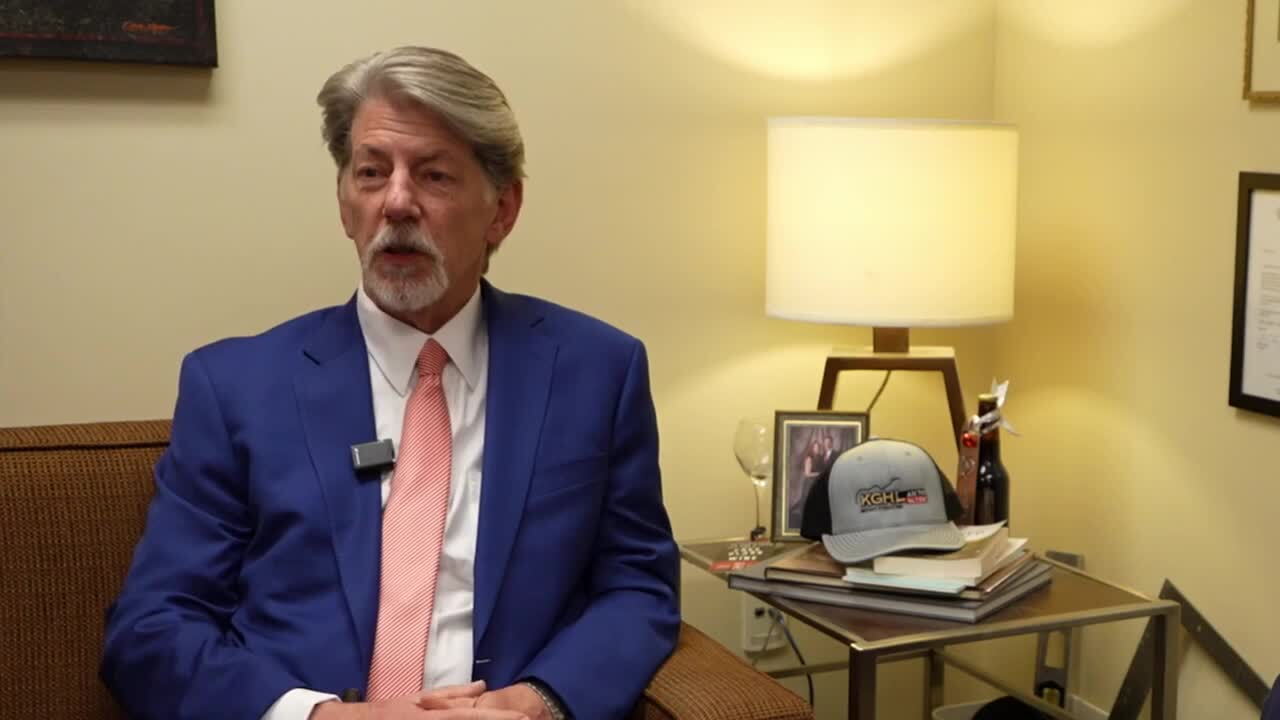
"Sometimes they'll go so far as to tell you that when the principal moves from one room to another, you have to lock all of your employees in a room so they don't interfere with the movement," said Mike Nelson, owner of the Northern Hotel and mayor of Billings.
Nelson recalled interacting with the Secret Service, saying they were tough, but great at their jobs.
According to Dutcher, the 36 full-time MetraPark employees all had their IDs checked during the week of a presidential visit. Anyone expected to be in close proximity to the president underwent even more rigorous vetting.
"They do an extra, extra background...they're gonna go through with a fine-tooth comb," Dutcher said.
Dutcher witnessed presidential visits from Ronald Reagan in 1982, George W. Bush in 2001 and 2006, and Donald Trump in 2018.
He says he also worked during candidate visits from future President Barack Obama, Hillary Clinton, Bernie Sanders and Trump before his election. Vice President Mike Pence also visited the Montana Pavilion during that era.
He said the first George W. Bush visit, in March 2001, stands out as particularly memorable.
"The governor was there. Both Montana senators were there. Both representatives were there. All three county commissioners were there. The Billings mayor was there," Dutcher said.
That visit drew 10,000 people to the arena. The White House press corps traveled on its own separate plane, bringing 100 media members who cover the White House.
Bush spent the night in Billings during that first visit. His second visit, in 2006, was a smaller event, about 5,000 people, organized through the Republican Party, arriving against the backdrop of the Iraq War.
Despite the intense security demands, Dutcher said working alongside the Secret Service was one of his favorite parts of the job.
"After about three days, you get to some back-and-forth talk, but they're just wonderful at their jobs," Dutcher said. "They're there to serve, and they're gonna get it right."
Working a presidential event also offered a perspective Dutcher never took for granted.
"For that hour that the president's on the floor talking — just think, that's one of the places that the whole world is watching," Dutcher said. "And that... was in Billings, Montana."
The crowd, he said, always rose to the moment, the kind of electricity that reminded him of a stadium rock show.
"You'd think it's no different than seeing the Eagles or Elton John or Motley Crue," Dutcher said. "Everybody's so excited."
In 1995, KTVQ got an unlikely call from the White House, which asked the station to host a live town hall with President Clinton.
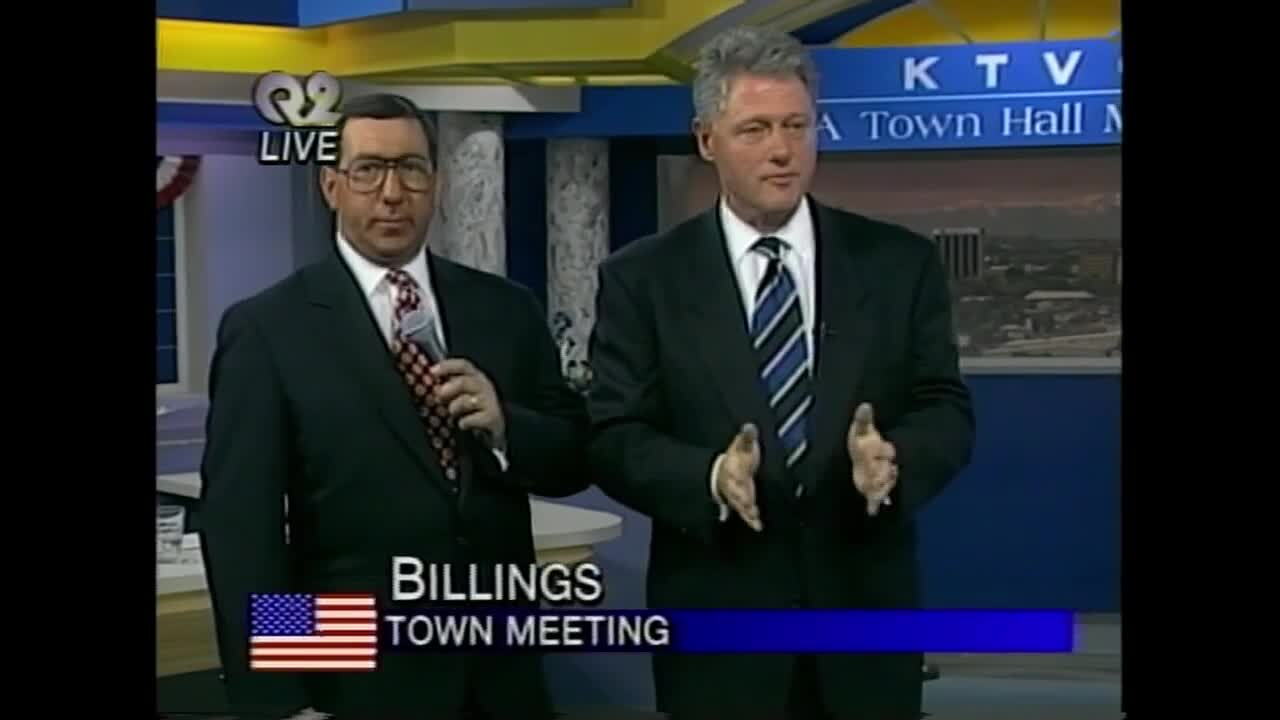
Gus Koernig, the former anchor and managing editor at Q2 News, hosted the broadcast. He said it was a moment that would leave an entire newsroom floating for weeks.
"That was definitely one of the top five things I got to do in my career," Koernig said.
Former longtime News Director Jon Stepanek received the call from someone in the White House Communications Office. His response was immediate.
"I'm checking with nobody. We'll do it," Koernig said, recalling Stepanek's words. The caller warned that Stepanek had no idea how much work it would be.
"Stations our size don't get invited to do town hall meetings with the president of the United States," Koernig said.
Related: Trump urges voters to back Flint and Alme at Kalispell rally
The preparation was intense. Koernig said the engineers got maybe four hours of sleep for an entire week. There was only about a week to prepare.
The studio was stripped down: the desk removed, bleachers built in on three sides, and the whole space relighted for the broadcast.
"The lighting was brutal. It was so hot in there," Koernig said.
Inside the newsroom, the reaction was a mixture of shock and excitement.
"It was between disbelief, how is this really happening here, and major excitement," Koernig said.
Koernig's recollection of the security preparations mirrored what Dutcher described at MetraPark. The Secret Service cleared the entire building — sending everyone, including office and radio staff, out to the street. They re-entered through metal detectors.
The only exception was Jeff Lowenthal, the station's master control operator at the time.
"It's the law, I can't leave this," Koernig recalls Lowenthal said. He said Lowenthal insisted on staying at his post to keep the station on the air. The Secret Service was not happy about it, but allowed him to remain.
Koernig had previously covered Clinton's health care program at the White House the year before, alongside colleagues Laura Thornquist and Nate Williams. Koernig says he believes that is how KTVQ appeared on the White House's radar.
About 60 people filled the studio for the town hall, with questions screened in advance.
Clinton arrived by limousine but got out to talk to the crowd on the street outside on Third Avenue North and North 32nd Street before heading inside. Koernig was standing next to a Secret Service agent when it happened.
"That makes your job easier, right?" Koernig said he asked the agent. The agent shook his head.
"He kills us," Koernig said, recalling the agent's reply.
Despite years of live television experience, Koernig admitted he was more nervous than he let on going into the broadcast.
"I was really nervous. I mean, I must've walked a mile between the newsroom and the studio for like the half hour, 45 minutes before we did it," Koernig said.
Once the cameras rolled, those nerves gave way to a moment he still vividly recalls decades later.
"I got to say, ladies and gentlemen, the President of the United States, and he came up the stairs from the basement, everybody applauded," Koernig said. "The microphone's tamped it down. It sounded like an explosion in the studio," he said.
Koernig opened the town hall with the first question, asking Clinton about the assault weapons ban, noting that about 50% of Montana men and about 30% of Montana women held game hunting licenses each year.
According to Koernig, the conversation ranged widely from there. The broadcast ran just over an hour live and was later picked up and rebroadcast on C-SPAN.
"Clinton is as natural an interview subject as I've ever been around," Koernig said.
After the broadcast ended, Clinton stayed for an additional 45 minutes visiting informally with station staff — a moment that Koernig said may have been the most memorable part of the night.
The VIP guests waiting in a separate studio room never got to meet him. Staff quietly agreed not to tell Clinton they were there, knowing they'd never get him out in time to keep the schedule.
"When he talks to you, you and he are the only people on earth," Koernig said. "He's not looking around scanning the room or anything like that. It's really a deep one-on-one conversation."
He says the staff floated for weeks after it was all over.
"Having a conversation with the president of the United States, I mean, who gets to do stuff like that, right?" Koernig said.
