

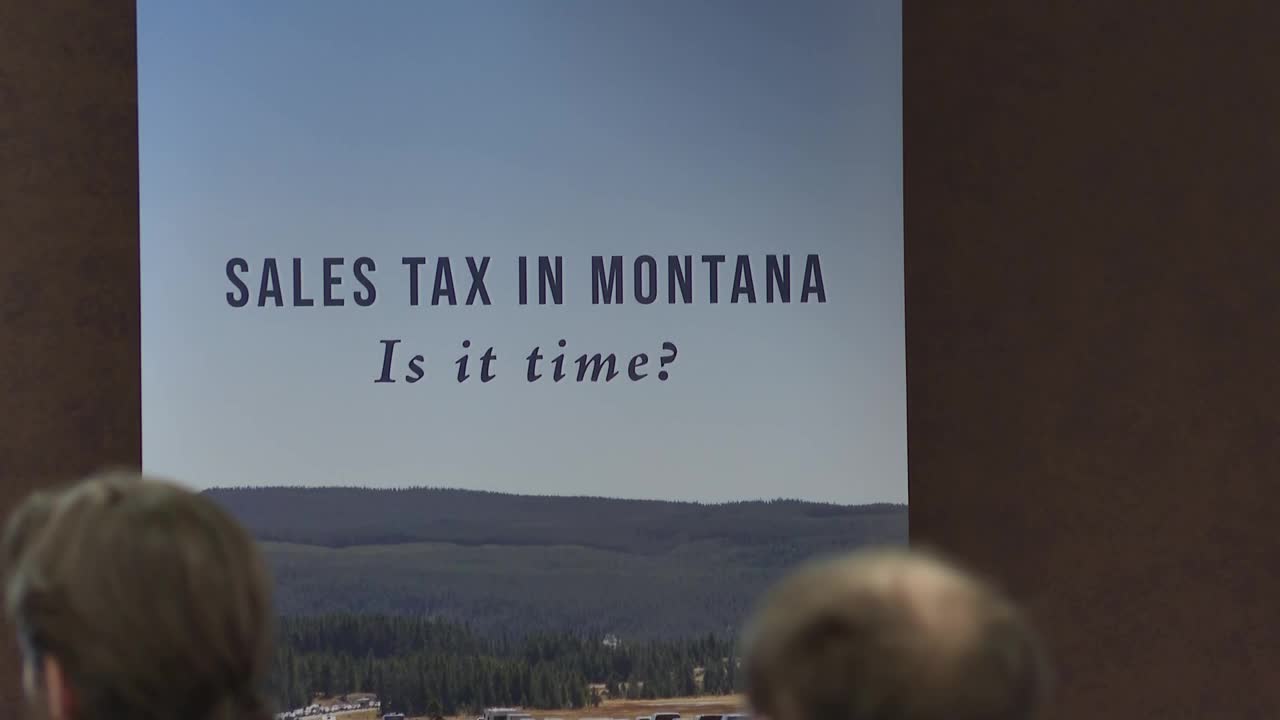


HELENA — For years, discussions about a possible state sales tax have been bubbling under the surface in Montana political circles. This year, the University of Montana’s Bureau of Business and Economic Research decided to make that issue the centerpiece of their annual Economic Outlook Seminar.
“It’s probably the most frequent question that we’ve received from people,” said BBER director of research Jeff Michael.
(Watch the video to hear more from the Economic Outlook Seminar.)
BBER kicked off a nine-city tour Tuesday morning in Helena, giving an update about Montana’s economic picture for 2026.
Michael says many of the people interested in a sales tax see it as a way to offset rising property taxes, or to try to collect revenue from non-residents who aren’t paying property or income tax. He said a general sales tax likely wouldn’t raise enough to completely replace property taxes, but it could help diversify revenue sources. However, he said it might not raise as much from tourists as people expect.
“In part that's just because Montana visitors don't spend as much on retail sales that are taxable as we might see in other states that get a lot of sales tax from their tourist economies,” said Michael. “We spend less on shopping, not quite as much in restaurants – they're out doing outdoor activities, and they're driving around spending a lot on gasoline.”
He said more targeted taxes like the lodging tax and the gas tax might be unpopular, but could be more effective at raising revenue from tourism.

One of the main concerns people have raised about a sales tax is that it would be regressive – hitting people with lower incomes harder than those with higher incomes. The Montana Budget and Policy Center released a report last week, arguing that Montana currently has one of the least regressive state tax systems, but a general sales tax would change that.
Michael agreed lower-income households could be more affected by a sales tax.
“Because they just don't save as much, and they spend more of their budget on those sorts of taxable sales,” he said. “That's absolutely true, and it would be true here in Montana. It’s one of the negatives against a sales tax.”
Some leaders have also talked about the possibility of creating a local-option sales tax, that counties could choose to introduce. Michael said he’d be concerned about the possibility of local-option taxes leaving some jurisdictions behind and distorting local governments’ decision making.
The keynote speaker for the seminar this year is Bob Story, a former state lawmaker and executive director of the Montana Taxpayers Association. His presentation focused on the long history of sales tax proposals in Montana.
“The first effort was in 1971; the last was every session,” he joked.

In 1971 and 1993, voters overwhelmingly rejected ballot measures to introduce a sales tax. Story said, in those cases, leaders were trying to raise money to balance the state budget. He said the situation is different today, as much of the interest in sales tax comes from concerns about rising property taxes.
“If you just ask the question right out, it’s a hard no,” he said. “But if you start saying, ‘Would you support one if it did these things’ – and mainly reduce your property taxes – then you get close to a majority, but it's still a ways away.”
In 1994, Montana voters approved an amendment to the state constitution that caps any future sales tax at 4%. Story says, for a sales tax to have a real chance of passing, leaders might need to propose additional protections first – like a guarantee that sales tax revenues would be used to offset property taxes.
“I think people are skeptical enough of government that they're not going to give a carte blanche,” he said.
BBER’s seminar tour will continue this week in Great Falls and Missoula, followed by events later on in Billings, Bozeman, Butte, Kalispell, Lewistown, and Havre.
