


BILLINGS — More than 65 volunteers fanned out across Yellowstone County Thursday night to take part in the county’s annual Point-in-Time count, a federally required survey designed to measure homelessness in the community.
Watch this story:
The count, conducted by the Yellowstone County Continuum of Care in collaboration with local service providers, provides a one-day snapshot of the number of people living in shelters, temporary housing, or unsheltered situations.
Last year’s survey counted more than 400 people experiencing homelessness in the Billings area, with previous years seeing almost 600.
Related: Volunteers start count of unhoused Billings residents
"It's kind of a snapshot of homelessness in the community," said Kody Christensen, community resource director for Downtown Billings. "It is a HUD requirement, so we do it the last Thursday of every year. It's how we figure out what gaps are in services in the community."
The U.S. Department of Housing and Urban Development requires Continuums of Care across the country to conduct the survey annually. The data is used to measure housing instability and helps HUD determine how to distribute resources and allocate funding to those in need. Several local organizations are involved, including the Community Crisis Center, Tumbleweed, Montana Rescue Mission, YWCA Billings, and Off the Streets.
Christensen said homelessness numbers in Montana, including Billings, have continued to rise in recent years, and organizers said they hope to help address the issue.
“Generally every year in Montana, our numbers just continually go up,” said Christensen. "That's due to housing issues in Montana, service providers' availability, there's a few factors that go into it."
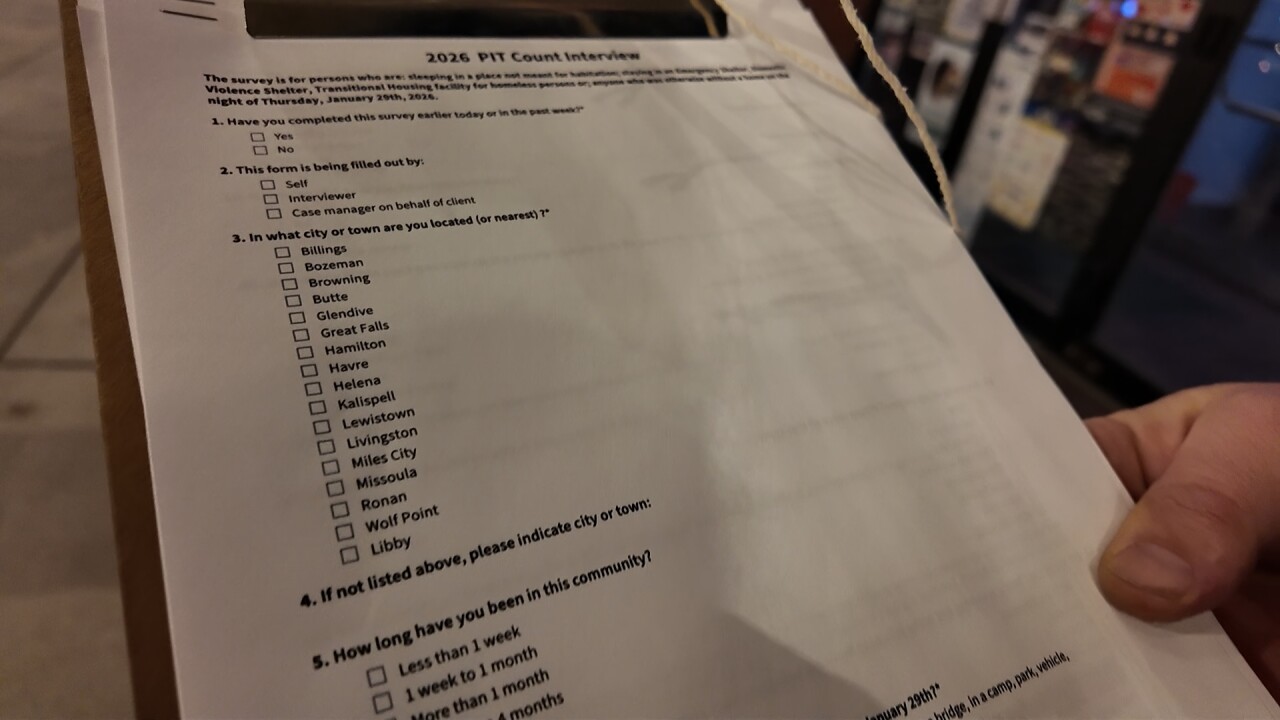
The survey asks how long they have been experiencing homelessness, where they came from, whether they are from the Billings area, and what factors are keeping them without stable housing.
Organizers said the survey not only provides critical data but also helps volunteers better understand the people behind the numbers.
"Every person has a story out there. It's always refreshing when I have volunteers come back, and they say, 'I had no idea.' So they just approached somebody and did a survey, but they just learned what got them to that point," said Christensen. "It could be as something as little as, 'I missed a paycheck, now I have a medical bill,' or something that put them in that position, and it makes them very relatable. It just humanizes everybody."
Results from the Point-in-Time count will be compiled and submitted to HUD in the coming months.
