



BILLINGS — As Americans gathered this week for holidays traditionally tied to faith, national data show that fewer people identify with organized religion. But in Billings, some churches and religious institutions say their experience does not fully match the national trend.
Watch how local churches and organizations compare to national averages:
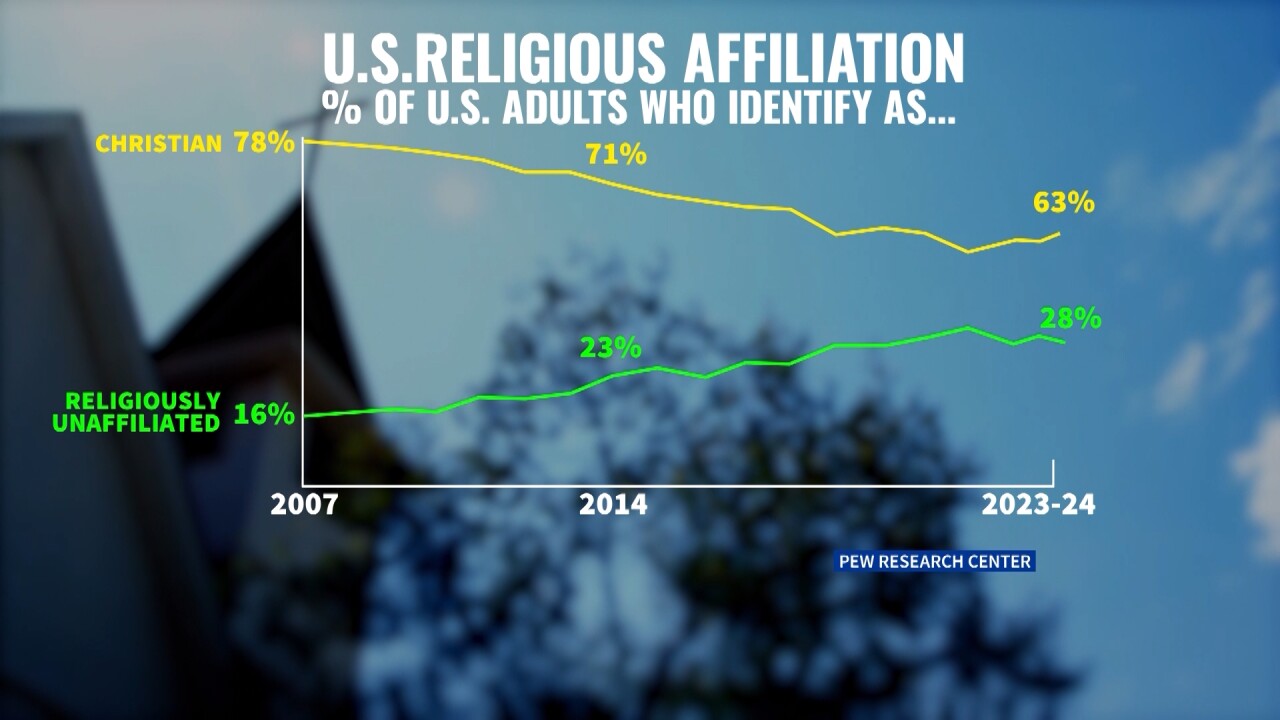
According to the Pew Research Center, about 28% of U.S. adults now identify as religiously unaffiliated, nearly double the share from two decades ago. Over the same period, the percentage of Americans identifying as Christian has steadily declined. While religious identification has remained relatively stable in recent years, experts say long-term projections point to continued disaffiliation.
At the same time, data shows a growing political divide among religious Americans, with those who describe themselves as highly religious being nearly twice as likely to identify as Republican rather than Democrat.
Yet, leaders at several Billings faith organizations say local engagement, especially among younger people, appears to be increasing.
At Harvest Church in the Heights, faith is paired with connection and community programming aimed at students and young adults. Volunteers Beau Barthuly and Noah Newman said the church has provided a sense of purpose and belonging.
"My first semester of freshman year is when I really grew into it, and it truly was like, I need to be in full submittance to the Lord and what He says,” said Barthuly. "It's very helpful in guiding you and making your decisions and helping your life be as prosperous and helpful to others."
“It ain't fun to live in a world filled with shame and guilt, and God was the burden taker,” said Newman, the church’s volunteer coordinator.

Barthuly noted attendance dipped during the COVID-19 pandemic, a pattern reflected across many religious institutions nationwide. Since then, Harvest leaders said attendance has rebounded.
Pastor Adam Barton said the church has seen a 17% increase in overall attendance, with particularly strong growth among Generation Z. Their student ministry has seen the strongest growth.
“They are actually the first generation in about four or five generations to stop the decline,” said Barton. “We've actually seen our student ministry go from 100 to about 260 over the past year, so an increase of about 150 percent with students. Students are actually coming to church without their parents."

Online sermons and fun student-focused programming have contributed to the increase, but most recently, they saw a major uptick after the assassination of conservative activist Charlie Kirk on Sept. 10.
“We grew just that Sunday. There were probably 400, 500 more people than our average normal attendance," said Newman. "I think it opened the eyes of a lot of people. They're like, 'Hey, wow. There is a lot of bad in this world, but there's a lot of good.'"

Newman said many young people he meets who join the church cite loneliness and a desire for connection as reasons for attending.
"More and more people are coming in, and I ask them, 'Why? Like, what brought you here?' And they're like, 'I feel alone. I'm missing people,'" said Newman.
That pattern extends beyond a single congregation. Carter Knight, dean of Montana Bible College, said periods of economic and social uncertainty, along with traumatic events, often correlate with increased religious curiosity, particularly among young adults.
“We see institutions fail us, not come through for us, and so this is really causing some uncertainty among young people in particular, and they're starting to see if there's something more,” said Knight. "This is a common thing that Jesus often addressed when people are living in difficult times, he has satisfying answers.”

Montana Bible College is an interdenominational school with several dozen students and is the state's only accredited Bible college. Knight said recent applications increasingly include stories from students who were not raised in religious households and are finding a new interest in faith.
Both Knight and Barton said they are observing a decline in what they describe as “cultural faith," or participation driven by tradition, and are instead seeing an increase in "authentic faith," people who seek religion intentionally and independently.
“Usually, what draws people to church is pain, pain in their life. Things aren't going well," said Barton. "They're looking for comfort. They're looking for answers, and that is what brings people to church. That part will never change.”
Knight said some Americans who select “no religion” may not be rejecting faith altogether but are hesitant to align with institutions.
"A lot of that is just simply institutional skepticism that people are having less and less confidence in a denomination or a particular affiliation," said Knight. "It's not that they're closed off, per se, by and large, but that they're simply not committed to a particular viewpoint as pertains to religion."

While national data shows fewer Americans formally identifying with religion, local leaders say Billings reflects a more nuanced picture as engagement may be growing, even as affiliation changes.
"We believe that God is entrusting more and more people to our church, and so we have to take care of them," said Barton. "We are working right now to make those adjustments."
Knight said Billings’ religious history could continue to shape future trends.
“In Billings, we have such a history of Christian faith, and it is well-rooted," said Knight. "For 2026, we're gonna see the trend of new believers and returning believers just to continue to increase, and I don't see it lessening anytime soon.”
